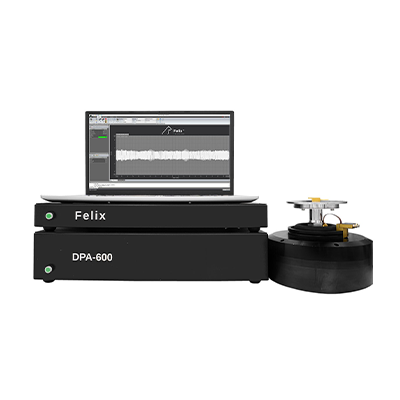
PIND Felix™ System: Operation and Features
The system PIND Felix™ It is designed to detect free particles present in electronic components. Fully programmable, it allows for automatic, fast, and accurate PIND testing according to various international standards.
Thanks to its interactive interface, the operator can configure a test sequence, monitor its progress, and control the various parameters. All system elements PIND Felix™ are designed and manufactured by Spectral Dynamics Inc. in the United States.
Composition of the PIND Felix™ system
The system includes:
- a vibrator equipped with a sensor; ;
- a DPA600 digital amplifier; ;
- a Felix™ controller; ;
- the software Felix™ installed on a computer; ;
- a STU (Sensitivity Test Unit) unit to verify the proper functioning of the system.
How the PIND test works
The PIND Felix™ system performs five main functions:
- the vibration of the component; ;
- the application of controlled shocks; ;
- the detection of free particles; ;
- displaying the acoustic signals generated by their impacts; ;
- recording of vibration, shock and acoustic detection data.
The vibrator applies vibration and shock to the component under test. When a free particle comes into contact with the cavity wall, it generates an acoustic wave. The sensor converts this signal into an electrical signal transmitted to the controller. Detection is indicated when the measured acoustic level exceeds the programmed threshold.
Key features of the PIND Felix™ system
Sensors
Depending on the test requirements, Spectral Dynamics Inc. offers sensors equipped with one or more crystals. Their shielding limits interference caused by unwanted electrical signals. An integrated accelerometer also allows for the measurement and display of the vibrator's actual movement.
Vibrator
The PIND vibrator generates shocks whose level can be adjusted by controlling the speed of the coil before impact.
Software
The software PIND Felix™ It ensures the acquisition of vibration, shock, and acoustic detection data. Each test can be recorded and replayed to analyze the interactions between acoustic noise and movement. Visual and audible detection facilitates component inspection.
Custom standards and testing
The system PIND Felix™ is designed to meet the requirements of applicable military standards for PIND testing, including MIL-STD-202, MIL-STD-750, MIL-STD-883 and MIL-STD-39016. It can also be programmed to specifications specific to each application.
How does PIND detection work?
The PIND test detects free particles present in cavity electronic components, such as relays, transistors, integrated circuits, and switches. These particles can cause short circuits and compromise equipment reliability.
During the test, a vibrator sets the particles in motion inside the component. When a particle hits the cavity cover, its impact generates an acoustic wave that propagates to the sensor.
The ultrasonic crystals integrated into the sensor convert this wave into an electrical signal. The shocks, generated by the vibrator and controlled by computer, dislodge the particle, while the vibrations keep the particles in motion and facilitate their detection.
The particles are therefore not measured directly: the PIND system analyzes the acoustic signals produced by their impacts against the cavity of the component.
To learn more about how the PIND test works, Download our brochure.
Options and accessories for the PIND Felix™ system
Vibrator options
- 4501-M230: Reinforced PIND vibrator for vibration and shock testing; ;
- 4501-M230R: Reinforced vibrator equipped with a wide impulse anvil; ;
- 4501-M230D: Reinforced vibrator equipped with two magnets.
Sensor options
- 100-S140C/A: 22 mm monocrystalline sensor; ;
- 100-S140C/AL: 50 mm monocrystalline sensor; ;
- 100-3S155-60: 60 mm multi-crystal sensor equipped with three crystals; ;
- 100-5S155-4: 100 mm multi-crystal sensor equipped with five crystals, including a central crystal and four arranged in a square at 50 mm.
Component fastening solutions
Two solutions allow the component being tested to be kept on the sensor:
Acoustic coupling gel
The coupling gel ensures excellent acoustic transmission while providing light adhesion to keep the component in contact with the sensor.
Double-sided adhesive pads
Aspedyn offers adhesive pads available in several sizes. They ensure excellent adhesion and good acoustic transmission. Their transmissivity remains approximately 10 % (1 dB) lower than that of coupling gel.
Other options
Remote control unit
The USB control unit allows the operator to:
- load a trial from the configuration library; ;
- start the selected or ongoing trial.
Anti-vibration mount
A dedicated support allows the vibrator to be isolated from the work surface and PIND tests to be carried out under good conditions.
Transport case
A carrying case is available to protect and easily move the equipment of the PIND Felix™ system.
More information about this product: